 DASAPT
Image compression factor
ICF (ξ) from crystallographic poles on detector hit maps, using theoretical versus observed inter-pole angles. At least two indexed poles are required.
Default reconstruction parameters are rarely sufficient. APT Calibrator collects methods developed over two decades into one interface.
ICF (ξ) from crystallographic poles on detector hit maps, using theoretical versus observed inter-pole angles. At least two indexed poles are required.
Iterative radius refinement from lattice-plane spacing, then kf from F = V / (kf R). Complements spatial distribution maps in AP Suite.
Estimate evaporation field from measured charge-state ratios (Müller / Kingham). The field is then used with tip radius and voltage to obtain kf.
Azimuthal equidistant projection, closer to APT geometry than gnomonic EBSD-style indexing. Supports LEAP 5000 XS/XR, TKD/EBSD orientations, and grain misorientation.
Fiducial markers from TEM/STEM used for depth-resolved ICF and kf. Useful when poles are weak, or for multilayers, precipitates, and nanocrystalline specimens.
Concentration or density iso-surfaces on a voxel grid with Gaussian delocalization. Surfaces can be shown from both sides, with cluster size and composition statistics.
Map concentration, density, peak ratio, or multiplicity through the reconstructed volume. Several saved maps can be shown together.

Move a slice through the reconstructed volume to see the atoms inside the needle.

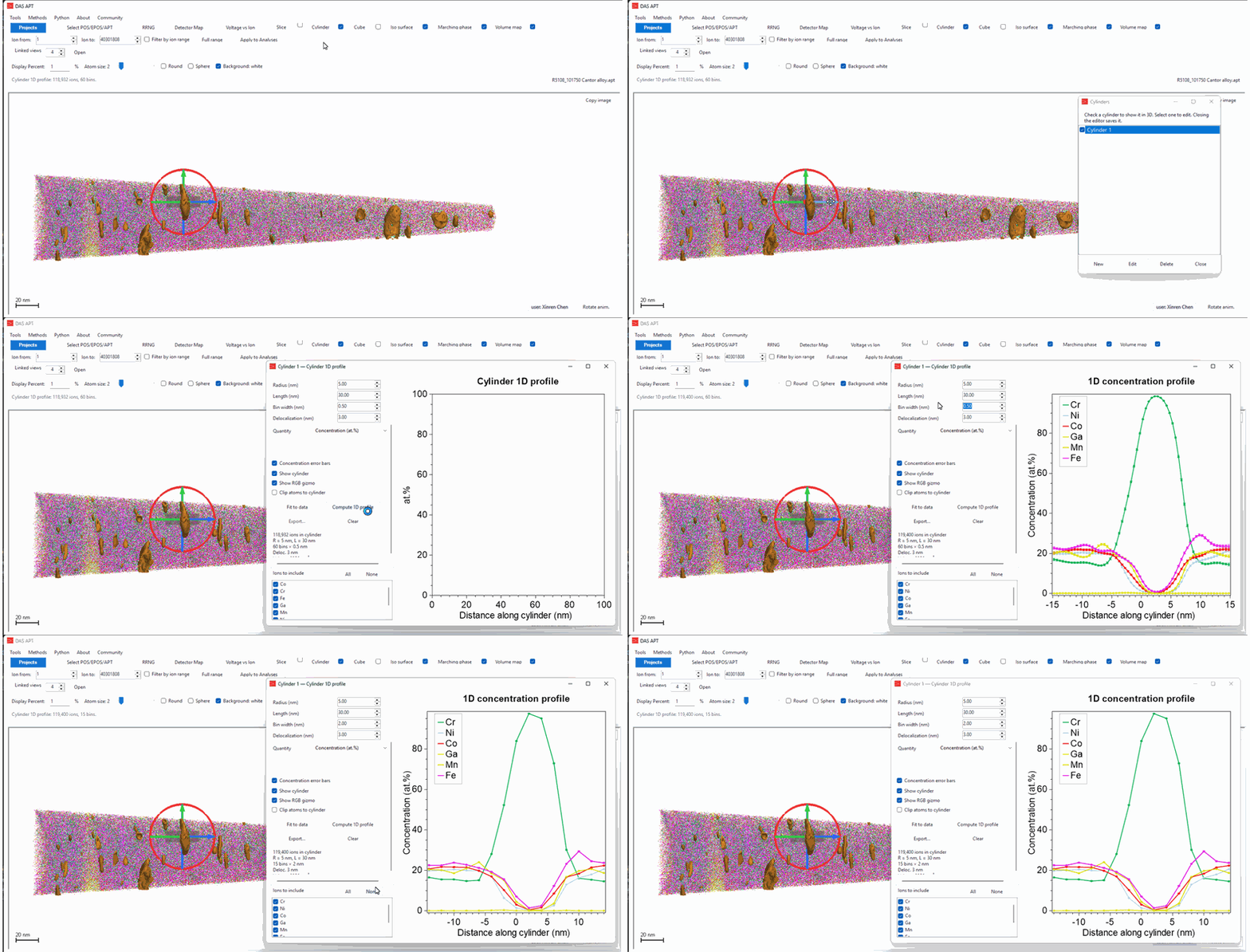
Place a cylinder ROI on the 3D reconstruction and measure composition along its axis. Requires reconstructed XYZ. Open it from the toolbar in Cluster Analysis or DAS APT.
Map hit-multiplicity density (singles, doubles, triples, 4+) as a volume in the 3D reconstruction. Requires an EPOS file.
Export from AP Suite, calibrate here, then return parameters or a reconstructed volume.
Build detector hit maps and spatial distribution maps in AP Suite. Index poles and iterate radius in APT Calibrator to obtain ICF and kf, then reapply them in the reconstruction wizard.
Export .apt to .epos, place golden seeds on matching TEM/STEM features, and compute depth-dependent ICF and kf. Reconstructions can be written as .pos files back into AP Suite.
If you use APT Calibrator in published work, please cite the paper.
Xinren Chen, Yue Li, Eric Woods, Xuyang Zhou, and Baptiste Gault. APT Calibrator: A Multifunctional C# Software Application for Reconstruction Calibration in Atom Probe Tomography. Microscopy and Microanalysis 31, ozaf092 (2025). https://doi.org/10.1093/mam/ozaf092
@article{Chen2025APTCalibrator,
  author  = {Chen, Xinren and Li, Yue and Woods, Eric and Zhou, Xuyang and Gault, Baptiste},
  title   = {{APT Calibrator}: A Multifunctional {C\#} Software Application for Reconstruction Calibration in Atom Probe Tomography},
  journal = {Microscopy and Microanalysis},
  volume  = {31},
  number  = {5},
  pages   = {ozaf092},
  year    = {2025},
  doi     = {10.1093/mam/ozaf092}
}
To prevent abusive downloads, enter your email and the verification code we send you. We will also create an account and an initial password for community, which you can change later. You can also simply continue through Google.